JAMB Syllabus 2027/2028 & Textbooks: For All Subjects
JAMB Syllabus 2027/2028 & Textbooks: For All Subjects: Topic-by-topic breakdowns, study tips, and recommended texts for major JAMB UTME subjects. Use these guides to plan your studies and practise past questions for better preparation.
The JAMB UTME syllabus contains the official topics, objectives and recommended textbooks for each subject. The latest available edition is the July 2025 release on JAMB’s IBASS portal. JAMB has not released a new syllabus for the 2027 UTME, so candidates should use this edition for now.
Every candidate takes Use of English and three other subjects. Use the syllabus to identify examinable topics, focus your studies and avoid wasting time on irrelevant materials.
As of 3 November 2026, JAMB’s Integrated Brochure and Syllabus System (IBASS) hosts the current 2026/2027 UTME syllabuses. The Board has not released a separate 2027 edition or announced its release date.
You do not need to wait for a new PDF to begin preparing. JAMB’s subject syllabuses generally remain stable from year to year, with only occasional changes. Download the current syllabus for each of your four subjects, build your study timetable around the listed topics and check IBASS again when 2027 registration begins.
What about the 2027 examination date? On 8 October 2026, the Federal Ministry of Education proposed 15–25 March 2027 for the UTME, with results expected in March. However, JAMB has not officially confirmed this timetable. Treat those dates as a planning guide, not a confirmed examination schedule.
How often does JAMB actually change its syllabus?
Some websites claim JAMB releases a completely new syllabus every January. However, syllabus changes are usually more gradual. Subject topics often remain stable across examination sessions, while recommended textbooks, objectives and examination guidelines may change.
Here are five things candidates should understand:
1. Topic lists generally remain stable. Subjects such as Chemistry, Mathematics and Government retain many of their core topics across sessions. This explains why past questions remain useful for preparation.
2. Recommended textbooks can change. For example, JAMB replaced The Life Changer by Khadija Abubakar Jalli with The Lekki Headmaster by Kabir Alabi Garba as the compulsory Use of English novel. Candidates must check the latest recommended text rather than rely on older reading lists.
3. Learning objectives may be revised. JAMB can adjust syllabus descriptions and learning objectives without replacing the entire subject syllabus. Pay attention to what candidates are expected to understand, explain, calculate or demonstrate under each topic.
4. Examination format changes are announced separately. Changes to registration, examination procedures and testing arrangements may appear in JAMB bulletins and official announcements rather than in the syllabus PDF.
5. The 2027 examination format is under review. On 16 September 2026, JAMB established a committee to examine the possible inclusion of life skills and critical thinking in the UTME. No final decision has been announced. Candidates should continue preparing with the existing subject-based format while monitoring official updates.
The bottom line: Do not assume that an old syllabus is automatically outdated, but always check JAMB’s IBASS portal for the latest topics, objectives and recommended textbooks before preparing for the 2027 UTME.
JAMB Syllabus 2027/2028 & Textbooks
What does the JAMB Use of English syllabus actually demand?
The JAMB Use of English syllabus is divided into three sections, covering 60 questions in total.
Section A: Comprehension and Summary tests candidates’ ability to understand written passages, identify main ideas, interpret expressions and draw conclusions. It includes two comprehension passages of approximately 200 words each and a cloze passage.
Section B: Lexis and Structure covers synonyms, antonyms, homonyms, clause and sentence patterns, word classes, mood, tense, aspect, number, concord, degrees of comparison, question tags, punctuation, spelling and idioms. JAMB also tests idiomatic expressions in formal, standard British English.
Section C: Oral Forms tests pronunciation and spoken English through vowels, consonants, rhymes, word stress and emphatic stress. It contains 10 questions.
The compulsory reading text is one of the syllabus components most likely to change. Always check the latest recommendation on IBASS before buying a textbook.
How is the JAMB Biology syllabus organised?
The Biology syllabus begins with three general objectives before presenting its subject topics in different sections.
Section A: Variety of Organisms covers living organisms, cell structure, evolution and the classification of Monera, Protista, Fungi, Plantae and Animalia. It also examines structural, functional and behavioural adaptations.
Section B: Form and Functions covers the internal structures of plants and animals, nutrition, food tests and the alimentary canal.
The learning objectives require candidates to compare plant and animal cells, trace the life histories of organisms and identify their economic importance. This explains why questions may ask candidates to identify the economic importance of insects, plants or other organisms.
JAMB Syllabus 2027 For Chemistry and Government
JAMB Chemistry covers 18 major topics, beginning with the separation of mixtures and purification of chemical substances and ending with chemistry and industry.
Other important areas include:
- Chemical combination, kinetic theory and gas laws.
- Atomic structure and chemical bonding.
- Air, water, solubility and environmental pollution.
- Acids, bases and salts.
- Oxidation, reduction and electrolysis.
- Energy changes, reaction rates and chemical equilibrium.
- Non-metals, metals and organic chemistry.
JAMB Government contains approximately 31–32 topics organised into four broad areas: elements of government, political development in Nigeria, foreign policy and Nigeria’s international relations, and international organisations.
Important areas include constitutional development between 1922 and 1999, federalism, local government administration and military rule in Nigeria. Candidates should also study political institutions, citizenship, political parties and Nigeria’s foreign policy.
These subject breakdowns provide a useful starting point, but candidates should consult the complete official syllabus for all topics and learning objectives.
| S/N | Subject |
|---|---|
| 1 | JAMB 2027 Use of English |
| 2 | JAMB 2027 Mathematics |
| 3 | JAMB 2027 Physics |
| 4 | JAMB 2027 Chemistry |
| 5 | JAMB 2027 Biology |
| 6 | JAMB 2027 Agricultural Science |
| 7 | JAMB 2027 Economics |
| 8 | JAMB 2027 Government |
| 9 | JAMB 2027 Commerce |
| 10 | JAMB 2027 Principles of Accounts |
| 11 | JAMB 2027 Geography |
| 12 | JAMB 2027 Literature in English |
| 13 | JAMB 2027 History |
| 14 | JAMB 2027 Christian Religious Studies |
| 15 | JAMB 2027 Islamic Studies |
| 16 | JAMB 2027 Computer Studies |
| 17 | JAMB 2027 Hausa |
| 18 | JAMB 2027 Igbo |
| 19 | JAMB 2027 Yoruba |
| 20 | JAMB 2027 French |
| 21 | JAMB 2027 Arabic |
| 22 | JAMB 2027 Home Economics |
| 23 | JAMB 2027 Music |
| 24 | JAMB 2027 Art |
| 25 | JAMB 2027 Physical and Health Education |
How the syllabus maps onto the JAMB UTME you will sit
Understanding the syllabus is only the first step. You also need to know how JAMB structures the examination, distributes questions and expects candidates to manage their time.
1. 180 questions in two hours. Use of English carries 60 questions, while each of your other three subjects carries 40 questions.
2. Approximately 40 seconds per question. You have limited time to read, think and select answers. Practise at this pace from the beginning of your preparation rather than waiting until the final weeks.
3. Every syllabus topic matters. Any topic listed in your subject syllabus can be tested. JAMB also reuses familiar question patterns across examination sessions.
4. No negative marking. Wrong answers do not attract penalties, so avoid leaving questions unanswered. Make an informed attempt when you are unsure.
5. Learn the CBT navigation system. Practise using the keyboard shortcuts for selecting answers and navigating between questions. Familiarise yourself with the previous, next, submit and reversal functions during mock examinations.
The mock UTME is optional and attracts an additional fee. In 2026, the registration fee was ₦7,200 without the mock and ₦8,700 with it. If you have never taken a computer-based examination, the extra cost may be worthwhile for the experience.
Which study plan works before the 2027 syllabus is released?
You do not need to wait for a new syllabus before starting your preparation. Follow these steps to organise your studies using the current IBASS documents.
1. Confirm your four subjects. Choose your subjects based on your intended course and institution using the official JAMB brochure. Do not copy a subject combination simply because a friend is using it.
2. Download your syllabus PDFs. Visit IBASS and save the syllabus for each of your four subjects on your phone for offline study.
3. Create a topic checklist. Break each syllabus into smaller topics and tick them off only when you understand the content and can answer related questions.
4. Practise past questions alongside each topic. After studying a topic, attempt questions on it. This helps you understand the depth of knowledge JAMB expects.
5. Pay attention to learning objectives. Words such as distinguish, analyse, evaluate and account for indicate different levels of understanding and the skills you must develop.
6. Study the recommended textbooks. Read the prescribed materials carefully, especially the compulsory Use of English novel. Summaries alone may not prepare you for questions about characters, events and motivations.
7. Start weekly CBT practice. From January, take timed practice examinations using the full 180-question, two-hour format. Avoid pausing or checking answers halfway through.
8. Check IBASS again before the examination. When 2027 registration opens, confirm whether JAMB has updated any topics, objectives or recommended reading materials.
What changes between now and the 2027 UTME?
Although the subject syllabuses provide a foundation for preparation, some examination details may change before the 2027 exercise.
Here are five developments candidates should monitor:
1. Registration dates and fees: As of the end of October 2026, JAMB had not announced the official 2027 registration dates, fees or deadlines. For comparison, the 2026 UTME registration ran from 26 January to 28 February, while the examination took place from 16 to 25 April 2026.
2. Examination session timing: JAMB’s September 2026 bulletin announced revised first-session arrangements, with candidates expected to arrive at 7:30 am and the examination scheduled for 8:30–10:30 am. Your examination slip will contain your actual reporting time and session.
3. Proposed pre-registration application: JAMB Registrar, Prof. Segun Aina, has discussed plans for a pre-registration application that could allow candidates to complete much of the registration process from home before visiting an accredited centre for biometric capture. However, the Board has not published a confirmed launch date or complete operating procedure.
4. Proposed overseas examination centre: JAMB announced plans to begin accommodating UTME candidates in Ottawa, Canada, from 2027. Candidates outside Nigeria should watch for further official guidelines.
5. Possible changes to the examination format: The committee established to examine the inclusion of life skills and critical thinking in the UTME may recommend changes. Until JAMB publishes a formal decision, continue preparing with the existing four-subject examination structure.
Final advice: Start with the available 2026/2027 syllabuses, master the topics in your four subjects and practise past questions regularly. You do not need to wait for the 2027 edition to begin preparing effectively.
How to get JAMB syllabus for 2027
You can follow these steps to find JAMB syllabus pdfs for any subject you will be examined in when sitting for your UTME test: Read m
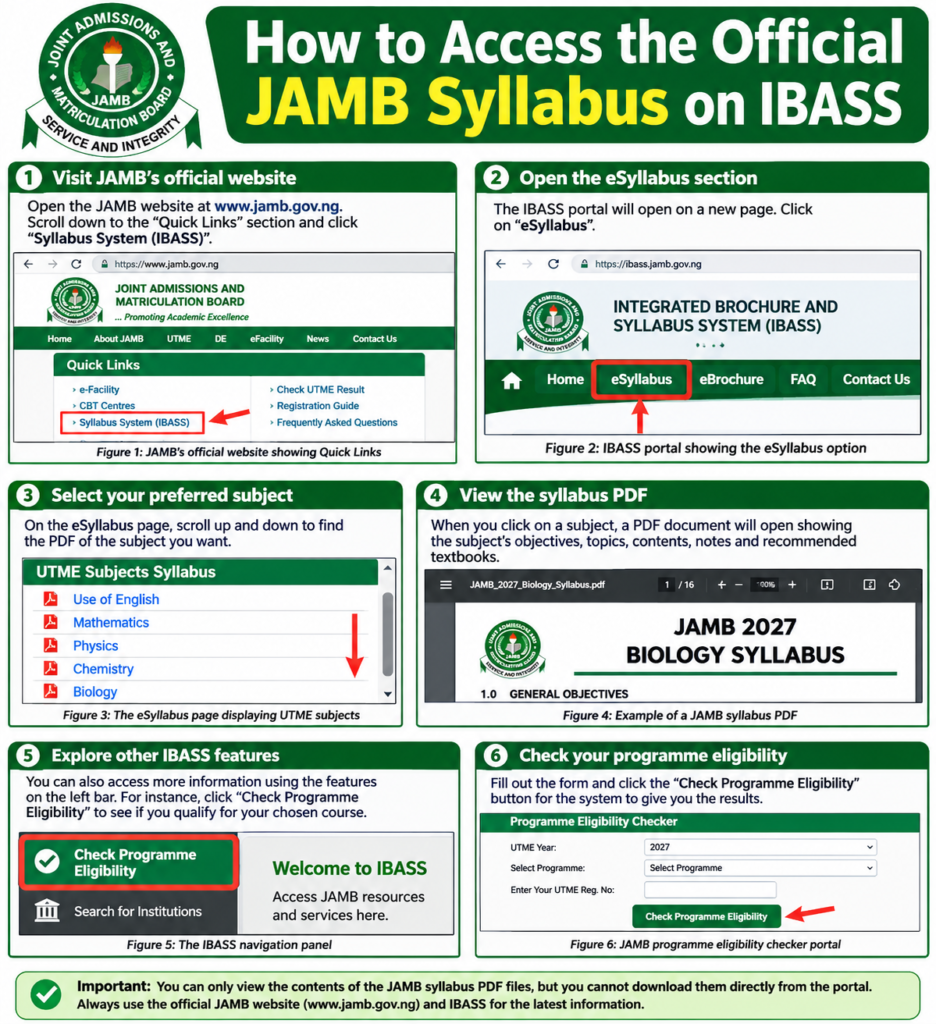
How to access the official JAMB syllabus on IBASS
JAMB provides its official subject syllabuses through the Integrated Brochure and Syllabus System (IBASS). The portal allows candidates to view subject topics, objectives, contents, notes and recommended textbooks.
Follow these steps to access the syllabus for your preferred subject.
Step 1: Visit JAMB’s official website
Open the JAMB official website. Scroll down the homepage until you find the Quick Links section, then click Syllabus System (IBASS).
Image 1: JAMB’s official website showing the Quick Links section. Source: jamb.gov.ng
Step 2: Open the eSyllabus section
The IBASS portal will open on a new page. Locate and click eSyllabus to access the available UTME subject syllabuses.
Image 2: The IBASS portal showing the eSyllabus option. Source: JAMB IBASS
Step 3: Select your preferred subject
After opening eSyllabus, a list of available subjects will appear. Scroll through the list to locate the subject you want to study.
Image 3: The eSyllabus page displaying available UTME subjects. Source: JAMB IBASS
Step 4: View the syllabus PDF
Click your preferred subject to open its syllabus document. The PDF contains important information, including:
- General and specific objectives.
- Topics and subtopics.
- Subject contents and notes.
- Recommended textbooks.
Read through the document carefully to understand what JAMB expects you to study for that subject.
Image 4: Example of a JAMB subject syllabus showing topics, objectives and recommended textbooks. Source: JAMB IBASS
Important: The availability of PDF viewing does not necessarily mean that every document can be downloaded directly from the portal. If a download option is unavailable, use the portal to view the syllabus online.
Step 5: Explore other IBASS features
The IBASS portal provides additional features through its navigation panel. You can explore these options to access other admission and examination information.
One useful feature is Check Programme Eligibility.
Image 5: The IBASS navigation panel showing the programme eligibility option. Source: JAMB IBASS
Step 6: Check your programme eligibility
Click Check Programme Eligibility to open the eligibility checker. This feature helps candidates determine whether they meet the subject requirements for their preferred programme.
Enter the requested information, select your preferred programme and examination subjects, then click Check Programme Eligibility to view the result.
Image 6: JAMB’s programme eligibility checker. Source: eligibility.jamb.gov.ng
Checking your eligibility before registration can help you avoid choosing an incorrect subject combination for your intended course of study.
Final tip: Always use JAMB’s official IBASS portal to confirm syllabus information and recommended textbooks for the 2027 UTME.
Recent Posts
- How to Upload Your O’Level Result on JAMB Online (2027/2028)
- JAMB Profile Code 2027/2028:Generate, Retrieve and Fix NIN SMS Errors
- JAMB e-PIN 2027: How to Buy, Price, and Where to Purchase
- JAMB Areas of Concentration For Yoruba 2027/2028 UTME
- JAMB Areas of Concentration For Hausa 2027/2028 UTME
- JAMB Cut-Off Marks 2027/2028 For All Courses
- JAMB Online Tutorials 2027/2028:Free Video Classes
- JAMB Cut-Off Mark for Criminology 2027/2028
- JAMB Cut-Off Mark for Crop Science 2027/2028 UTME
- JAMB Christian Religious Area of Concentration for Studies 2027/2028 UTME
- JAMB Cut-Off Marks 2027/2028 For All Courses
- JAMB Cut-Off Mark for Music 2027/2028
- JAMB Commerce Areas of Concentration for 2027/2028 UTME
- How to Apply for JAMB 2027/2028: Complete Registration Guide
- JAMB Mathematics Areas of Concentration for 2027/2028 UTME
- JAMB Economic Areas of Concentration for 2027/2028 UTME
- JAMB Chemistry Areas of Concentration for 2027/2028 UTME
- JAMB CBT Form 2027/2028 And Exam Date

JAMB Syllabus 2027/2028: How to Use It to Study Smarter

JAMB Area of Concentration for Use of English 2027/2028

JAMB Approved CBT Centres in Zamfara State 2027/2028
About Author